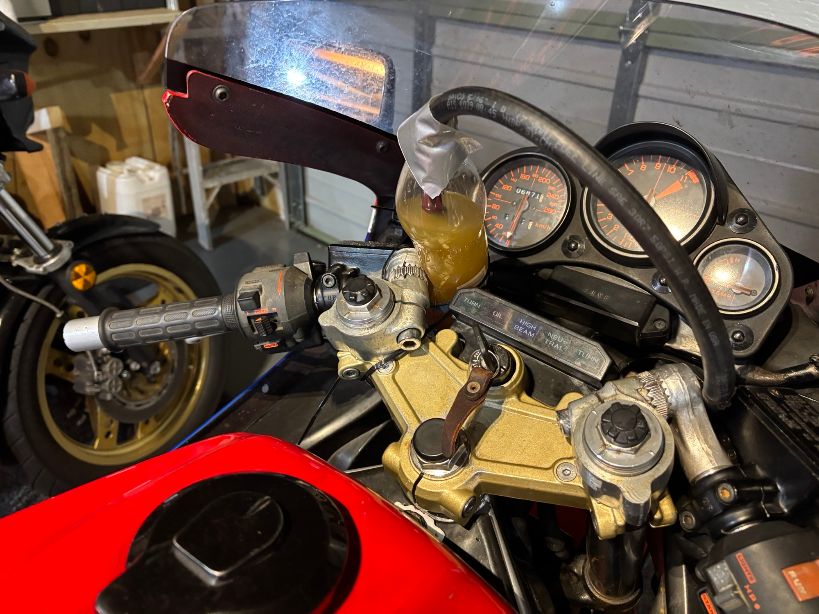
Based on the VF1000F cooling system procedures, a recovery system that pushes coolant to the reserve tank but doesn’t draw it back on cool-down usually comes down to one of four things: cap performance, a small air leak on the vacuum side, a restriction in the overflow path, or an unresolved leak elsewhere in the system. Here’s a focused checklist using the manual’s tests/specs.
What to verify
Radiator cap performance and spec: Pressure-test the cap and confirm it holds and releases within 75–105 kPa (10.7–14.9 psi) for at least six seconds; replace if it doesn’t meet spec. An out-of-spec cap will vent early on the road and crowd the reserve tank .
System pressure integrity: With the cap off, pressure-test the radiator/engine/hoses to 1.05 kg/cm² (14.9 psi) and confirm it holds for at least six seconds. Even a tiny leak will let air in as the engine cools, preventing the vacuum draw from pulling coolant back from the bottle .
Overflow path clear and airtight: Inspect the filler neck nipple and the entire overflow tube to the reserve tank for blockage (you mentioned brown debris earlier) and for any cracks or loose fits that could admit air. The manual shows the overflow tube connection at the filler neck—make sure this joint and the hose are sound and unobstructed .
Coolant fill/bleed and level: Refill and bleed per the manual until all bubbles cease and the level stabilizes, then set the reserve tank to the correct mark. Total capacity is 3.4 L (radiator/engine 3.0 L, reserve 0.4 L). Overfilling the bottle when cold will naturally push excess to the tank under load, especially on the road .
Water pump and seals: Check the telltale hole for any sign of mechanical seal leakage, and inspect O-rings; a leak here may not drip visibly while riding but can admit air on cool-down, stopping recovery flow .
Thermostat/fan operation: You’ve checked the thermostat (opens 80–84°C; ≥8 mm lift at 95°C), and your fan does come on. For completeness, the fan switch should close at 107–113°C; if it’s late, pressure will rise more on the road than at idle .
Radiator/engine passage cleanliness: Given the “brown junk,” confirm there are no blocked passages in the radiators/hoses/water jackets that could cause localized boiling and extra expansion under load, which will expel more to the bottle .
If all the above pass, but the bike still fills the bottle on the road and won’t recover, proceed with two final checks from the manual:
Cap again, but with a known-good tester cap at 75–105 kPa to rule out a marginal new cap (some new caps test low) .
Engine condition check: Perform a compression test. A leaking head gasket can introduce combustion gas into the cooling system without obvious overheating, increasing pressure and purging to the bottle; the manual lists leaking head gasket under low/uneven compression indicators .
Bob has been very thorough.I would suspect from what you have tried that there is a blockage in the water jacket.VFPete’s topic Project ratty R is a case in point.
Regards Bif
OK update.
Got it hot with a ride and problem showing as per video.
Came back to shop and removed back splugs ,disconnected spark and ran up with no bubbles so it appears rear cylinder’s.
Going to check oil press before removal then a compression test.
Checked oil press when hot idle was 20 psi - 80psi 6000 rpm.
Cold compressions 150 both front - 205 both rear.
Warm compressions 160 both front -215 both rear.
Have not checked valve clearances until engine out
Splug all a light gray and even
Question to all would you rebore and rebuild that’s if clearance’s are ok.